When they’re running late to an 8:00 a.m. class, scanning their U-Passes is the last thing on student’s minds.
Many post-secondary students take public transportation to get to school, yet you’ll see very few pay attention to the scanners or signage reminding riders that the fare is mandatory. There are those who ignore paying the fare at every station platform, but it seems to be status quo when going to and from school stations.
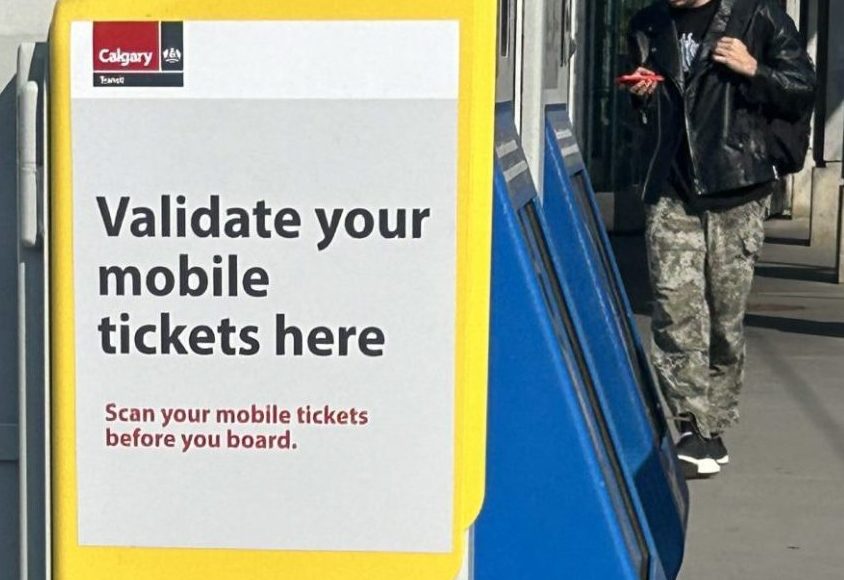
Calgary Transit introduced a new method for verifying mobile tickets in June 2025, with scanners installed at the train station platforms across the city before boarding. This is in stark contrast to other cities across Canada, where riders have to validate their tickets before accessing the platform guarded by a gate. Since their implementation the fare has been raised to four dollars, one of the highest in the country, which is a contributing factor for many to forgo paying the fare, although not a primary concern for those with U-Passes during the school year.
As of June 2025, the City of Calgary reports that there were 401,751 U-Pass holders who used Calgary Transit, with there being four main post-secondary institutions being along the C-Train’s Red Line. Due to U-Passes being a mandatory payment within student’s tuitions in Calgary, with students having to go out of their way to get rid of it, many students within the city are incentivized to use public transportation to get to class.
“Everyone just walks past,” said Adden Mirza, a student at the Southern Albertan Institute of Technology. “I never see people do it.”
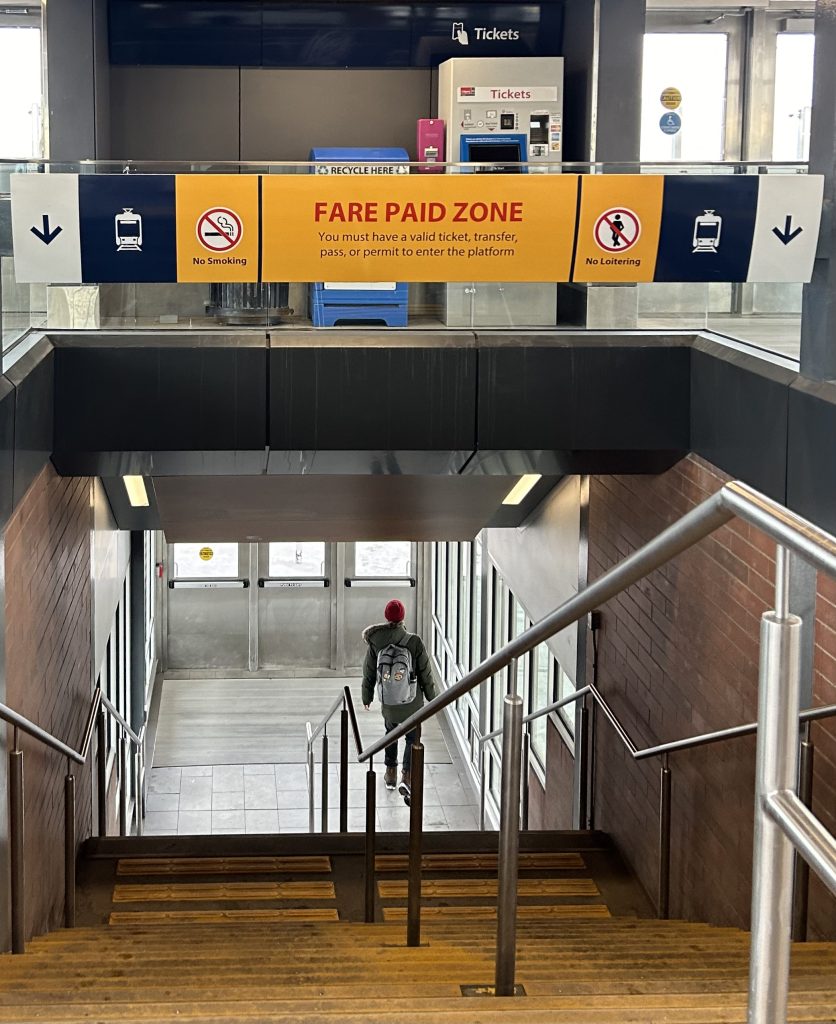
Image: A man walks down the stairs at University Station along the Red Line of the C-Train in Calgary on Monday, March 9, 2026. The signage that hangs above the stairs is a reminder about paying the fare, with many machines to purchase and verify tickets surrounding the upper platform.
While children under 12 are allowed to ride without paying, fare enforcement is not prevalent for most riders. According to a brief held February 10, Transit Peace Officers didn’t issue any tickets to those who failed to provide proof of age when riding Calgary Transit, with them saying that the funding they’d need to manually review the increasing amount of tickets would exceed $4000.
“I feel like a lot of us are kind of us are kind of apathetic about it, especially because it’s just kind of a permanent pass, like per the semester,” said Lilac Herzog, a student at the University of Calgary. “So what is scanning it really accomplish? I think that’s kind of the mindset.”
There are many factors that can contribute to students ignoring the scanners at stations, including the recency of this change for students who follow the traditional semester patterns. This new method is three months shy of being in effect for a year, and there’s room for both commuters and Calgary Transit to improve the ridership verification rates.
Calgary Transit doesn’t currently have the information regarding the consistency of U-Passes being scanned, they have stated in the past that. For now, Calgary Transit says that students can choose if they scan their pass when transferring after that initial scan when first boarding. Whether they review the efficacy of scanners at certain stations is a future project for the city, though for now they may continue to sit untouched despite the crowded platforms.
Featured Image: A Calgary Transit ticket scanner at Somerset-Bridlewood station.
Leave a Reply